Showing posts with label pastured poultry. Show all posts

Thursday, May 17, 2012

Week 8 - Routine

Well both I and the chickens have finally settled into a regular routine. I take care of them twice a day, usually 8:00am and 4:00pm. Move the hoop house, fill the water bucket, fill the feed trough. The chickens are eating less feed and more grass now so that there is a little bit of feed leftover, and when I fill it up they don't go into a feeding frenzy anymore. In fact usually just a few at a time will eat the feed while the rest peck at the grass and weeds.

Speaking of grass and weeds, what is left of my "pasture" is mostly weeds and very little grass. I have seeded it three times now but not much seems to grow but cheat grass and weeds. At least the goats and the chickens are keeping it ate down and I don't really have to mow it anymore. This fall I am going to put in sprinklers if it kills me. Right now I am dragging around hoses and two tower sprinklers, but I don't like running them all the time off my well pump. I really need to get an irrigation pump and hook into that. Hopefully next spring the pasture will be in better condition.

Anyhow, if the chickens are on a patch with very little grass, I move them one extra time per day, usually around noon. Here are some pictures I took this afternoon just after moving the hoop house, and as you can see they are happy as clams to get to new ground.


Mr. White is always at the center of attention. Plus he is easy to photograph cause he makes a great target in the sea of meandering reds.


Here is a very curious Roo. The chickens are getting used to me coming inside twice a day and don't run away or panic much anymore. I can usually even pet them for a second or two before they squawk and run.  This guy came right up to me and almost stuck his beak into the camera.


The other morning at first light one of the Roos made a (feeble) attempt to crow. He hears my neighbors roosters and is trying to copy them but it sounded more like a wounded cat than a "cock a doodle-do".

I discovered a couple new mole hills in the pasture this week. So yesterday I got the hose, put it in the hole and flushed out the mole, and got it into a bucket, and filled it with 6 inches of water. They only struggle for less than a minute. Seems like a simple, clean and humane way to get rid of them before they make an utter mess of the ground. Much easier than traps and smoke bombs, never had any success with those. I had an infestation of them on the other side of my property several years ago and didn't know how to get rid of them, so now that section of ground is all uneven and rutted which makes it a pain in the butt to mow. So I now have a zero tolerance policy for moles.


Here is a good example of a pretty pullet. They seem to be lighter in color and with less black in the feather tips.


The Roo's are definitely bigger than the pullets and will probably get processed a week or 10 days before the pullets do. I probably need to start thinking about scheduling the processing and start working on building some transportation crates. That will probably be my next project.

Wednesday, April 11, 2012

Hoop House Build

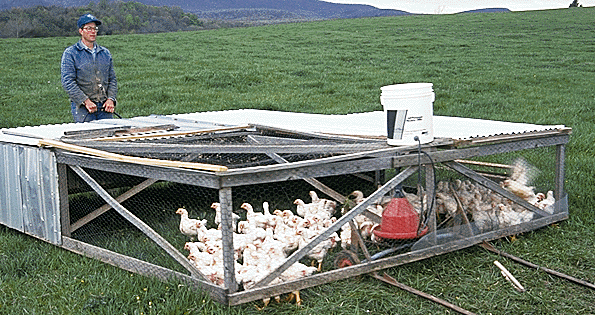
Well (finally) here are some pictures of my hoop house! Several folks have asked me for plans but this build was done ad-hoc so I didn't really have any plans to share. So, here are some links to a few different plans for building a similar hoop house/coop: 


The basic idea behind pastured poultry is to move the chickens to fresh grass each day. So the pen needs to be light enough to pull with a rope by a single person or a riding lawn mower. Lots of people use a 10x10' pasture pen that is only 2 feet high. I chose a hoop house over a pasture pen because I can walk inside to change out the feed and water, catch chickens, etc.

It has an 8x12' foot print and is 6' high, enough to be able to walk around inside. It is basically made of 3 "ranch panels" (4 gauge galvanized welded wire) that are pushed up into a hoop inside of the pressure treated frame. I put a heavy duty U.V. protected tarp over the back 8' leaving 4' open (covered in chicken wire) for sun and ventilation. I covered the perimeter with 4 foot high chicken wire in case the tarp rips or I want fold it up on the sides. Attaching the chicken wire was very laborious, even using wire "zip" ties. Make sure to use the black (U.V. protected) ones.


The ends were the most difficult part to figure out. Chicken wire by itself is not predator proof and the ranch panels were too cumbersome (and very sharp at the ends) to use. I have been saving this piece of 3/8" ACX plywood for years and finally found a good use for it. I just tacked it in place and traced out the hoop and cut it to fit. I did not want it to become a 3 sided parachute in the wind so I put in a foot of chicken wire near the top of the back so the wind will go through it. The A-frame 2x4's are to keep the ranch panel at the peak in place and help support the plywood as well. I probably need to put some stain or paint it or it won't last very long.


My son's dog "Moo Moo" (cause his coloring looks like a cow) for some perspective of the size.


The door on the front is almost 3x6' and has sprung hinges (screen door style) and two locks. I purposely made it swing out so that if a predator tried to get in it couldn't push its way through. Later on I added some left over heavy wire fencing to the door and the front to beef up the chicken wire. Next time I will use plywood or 2" welded wire covered with chicken wire for the ends.

LESSON LEARNED: Chicken wire sucks. Use alternatives when ever possible.


Nice and cozy inside, yet some sun and lots of ventilation. I think I will add some roost bars at the back and I need to build a feed trough (maybe out of plastic rain gutter) and get some "chicken nipples" for a 5 gallon water bucket. I will hang the water bucket from the peak near the door to make it easy to change out. And the feed troughs will probably sit on the corner braces so that they move with the house when I pull it to fresh grass each day.

Turns out that my new neighbor across the street raises Black and Blue Copper Marans (very dark brown eggs) and Ameraucana (blue Easter Eggers) on his small family farm (www.rolofarms.com) and is making some decent money at it selling chicks this spring. He asked me to build him one or two of these hoop houses for his extra cockerels. I ended up using 5mm under-layment plywood on both ends but had to primer seal it because it wasn't exterior grade plywood. Here it is just before I put the tarp on. Its a little different but probably stronger than mine.


Tuesday, February 28, 2012

Freedom Ranger to the Rescue

One thing I hadn't really given much consideration before starting this project was what kind of chicken to raise for meat. So I talked to my chicken raising friends and did some research. Here is what I found out.

I am pretty disgusted with the Cornish-X ("Cornish Cross") hybrid that is typically raised for meat, especially in commercial/industrial farms under deplorable conditions. It's not the chicken's fault, although they act pretty stupid. I read accounts of huge losses days before slaughter because a of a hot spell and the chickens were too fat/dumb/lazy to walk 5 feet to the watering can and died of overheating.


You see the Cornish-X has been bred specifically to grow very large breasts very quickly, in as little as 6 to 8 weeks from hatch to slaughter! This unnaturally rapid growth rate leads to lots of problems, including heart attacks from the inability of the heart to keep up, or weak and broken legs that are unable to support the large breast weight resulting in breast ulcers from dragging on the ground, starvation and overheating and death from inability to reach feed and water. Not to mention cannibalism, aggressive pecking, bruising and broken bones and disease from overcrowding and unsanitary conditions found in most "industrialized" chicken farms. Makes me never want to eat another store bought chicken or at KFC ever again.


Thankfully there are other meat breeds such as the "Freedom Ranger" or "Red Ranger" that grow a little slower (10 to 12 weeks) and thus avoid many of these problems. They are also better suited for pasturing or day-ranging because they are able to walk and forage for themselves. Of course those extra 4 weeks add up to a lot more feed and thus the conversion cost per pound of meat is considerably higher. And the price of day old chicks are 150-200% that of the Cornish-X. But I have heard that the meat is much better tasting, and my pasture will benefit from the grazing and manure, and I can sleep at night knowing that I am helping to promote Sustainable Agricultural Practices and avoid the problems that come with the Cornish-X.


Then there are also the "duel purpose" Heritage breeds such as the Rhode-Island Reds and Plymouth Bardrocks that can be raised for a season (8-12 months) as a laying hen, and then slaughtered for meat. But I already have all the eggs I need and don't really want to wait a full year to get some meat.

Now it is not even the end of February and I was hoping to get my chicks delivered on or about the 1st of March in order to be finished before the real heat comes in June. However, I have discovered that finding local breeders that produce Freedom Rangers are hard to find, and those that do are sold out till April.

LESSON LEARNED: Order your chicks early.

To reduce costs, I went in with a friend and ordered a 100 straight run chicks, 50 a piece, in order to take advantage of bulk pricing (about $1.80/ea.) I will post the supplier and details as soon as I get their contact info. The chicks are expected to arrive about Mid-March which is great considering that everyone else quoted me the end of April.

I have been so excited with plans for the hoop house shelter and finishing the fencing around my 1 acre pasture that I completely neglected to consider where the day old chicks are going to live for the first few weeks. Guess I better start looking into building a brooder box or two big enough for 50 chicks.


Where's the Chicken?!?

For the last year and a half I have been raising a handful of hens for eggs. I started with 5 pullets (2 Rhode Island Reds, 1 Golden Sex-link, and 2 Plymouth Bared-Rocks) in expectation of gathering a few eggs each day. Not enough to sell but enough to feed our family and occasionally give some to friends.


The goal was to allow them to free-range during the day on our 3 acre yard and return to a coop for laying and roosting at night. What I quickly learned is that everything loves to eat chickens, including several neighborhood dogs. I have had to replace 2-3 hens at a time on 3 different occasions now, and have spent hundreds of dollars on fencing. Currently we are down to 5 hens, none from the original 7, but we are getting an average of 4 incredibly delicious eggs every day.


Living in a rural community we have been spoiled with grass-fed beef grown and butchered locally. But we eat a lot more chicken than beef. Last year we bought several whole chickens from a friend that raised them as "All Natural" without hormones or medications and fed an all vegetable diet. This year I have decided to try raising some meat chickens ("broilers") on our own. After doing some research I decided to try the "Pastured Poultry" method as promoted by Joel Salatin.


I am planning to raise a single test batch of 50 chicks on one acre of fenced pasture with a movable 8x12' hoop house shelter. I would like to keep half of the processed chickens for our family and then sell the rest to recover some of the expenses. If all goes well I will consider expanding to second batch later this year, or maybe 2 to 3 staggered batches next year.

I think the deciding factor will be if I can break even or not and still provide some good quality meat for my family and friends. I know that with initial start-up costs (hoop house, brooder box, losses from inexperience, etc.) that will not happen with this first test batch of only 50 chicks. I am pretty sure that I will have to buy feed in bulk (1000lb totes) to get the price down enough to make this a practical venture. But I am unsure how many chicks will survive to processing, how much feed each will eat, or how many chickens one acre can support at a time or how long it will take the pasture to recover between batches. That is why I will be tracking all of this here, and sharing my experience and lessons learned with any one else that may be considering raising broilers.