Showing posts with label cornish cross. Show all posts

Friday, June 8, 2012

The Roosters are in the FREEZER!

Well the day finally came to say good bye to half of my feathered flock. I got up early and had a cup of coffee to start things off on the right foot. Yesterday I strategically placed the crates near the fence and loaded the ice chests into the truck and backed it up to the fence so that I would have time this morning to catch the roos. I wanted this to be as stress free a process as possible but I didn't want to do it in the dark last night and have them endure the confines of the transport crates all night. So I decided to do it in the morning about an hour and half before I had to be on the road to the processor.

Catching the roosters was fairly easy as they are pretty used to me going inside the hoop house a lot. However getting them to go in the crate with one hand without letting others escape was another story. It was especially difficult because of my sore thumb (table saw accident 11 days ago). I tried to move very slow and not get them all frantic which worked out really well, in fact once I got one in the crate others would come to investigate so I just grabbed one at a time and tried to get them to relax a little before putting them in. The hardest part was lugging the full crate out the spring loaded door of the hoop house. I was surprised how much 7-8 chickens weighed. I originally thought my flock was about 2/3 hens and 1/3 roosters. Wrong, I have exactly 50-50. The only roo that got a repreive was Mr. Waddles because of his smaller size, so I did end up taking the largest hen instead.

Mary from The Hen Connection brought over a mating pair of Royal Palm Turkeys that she has been hatching eggs from for the last few months. I guess they were escaping all the time and she couldn't afford to lose them nor sell them for what she paid for them so they got to come along for the ride to the processor. The drive over to Fruitland is about 40 minutes and none of the birds had any problems. Finding 20lb. bags of ice was a problem though, only one store in town carries them. So I saved about 4 bucks buying the larger 20lb. bags at $3 each compared to 8lbs. for $1.60.

The processor is a small family business and they were really nice and accommodating there at Countryside Poultry Processing. I got to watch everything and talk with the gals about it all. And I got to compare notes with other folks there getting their birds done. Most of the others were Cornish-X and were pretty good looking at 5.5 lbs or so, but she had 3 carcasses thrown out because of congestive heart failure and had lost 15 chicks in the brooder! I only lost 3 chicks in the brooder and 1 rooster at 7 weeks. My roos came in right about 4lbs., some 3.5, others 4.5, which was exactly what I was hoping for. And the cryo bags are vacuum sealed. All in all I was very happy with the processer and would definitely recommend them, especially since their price is almost a $1 less per bird than their competitors. So $65 for 23 chickens (I must have miscounted when I caught the first batch cause I was intending on 22, oh well.)

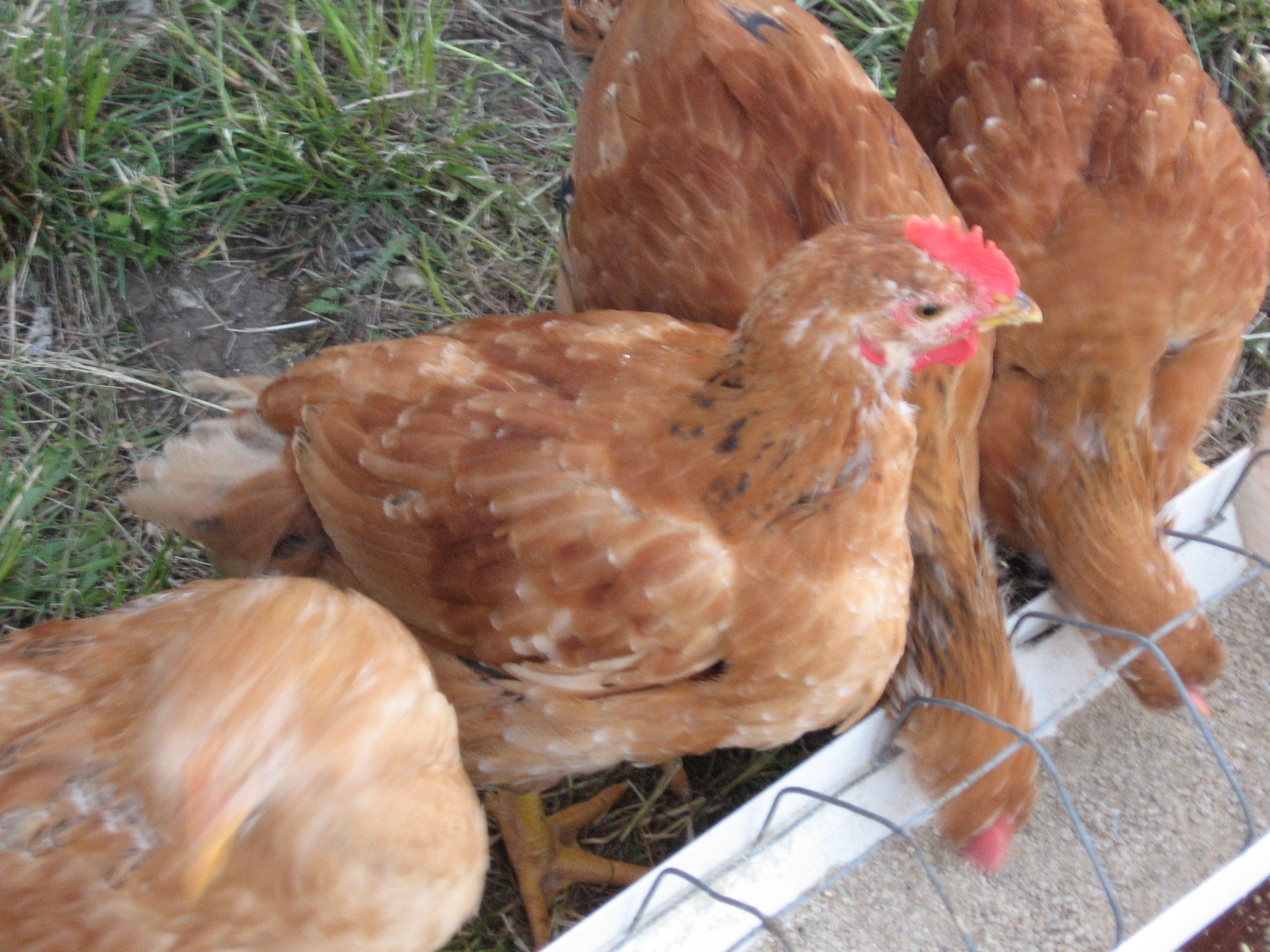
Here is a couple of the finished chickens. Note the yellow skin and longer breast keel and legs than your standard industrial grocery store Cornish-X. I hear these taste better too. We will find out soon enough.


My freezer is pretty full now, but about half of this batch are already spoken for. If the rest don't sell before I process the hens I will have to drop my price a little. Noticed I was able to save much of the ice for next time. The Hens are scheduled on the 20th so they will be exactly 12 weeks plus one day old. Now that they have some room in the hoop house and no aggressive roos to keep them out of the feeder, I am hoping that they will plump up nicely in the next 12 days.


Thursday, May 3, 2012

Week 6 - Fixed Roosts

So here we are entering week 6, that makes the chickens 5 weeks old, almost half way through their projected life span. I have been watching lots of videos on YouTube such as Joel Salatin - Pastured Poultry - Part 1 and Michael Pollan - The Omnivore's Dilemma and I highly recommend that you watch some too. Its amazing to me how the industrialization of food has separated us from the source of our food and thus respecting and appreciating the plants and animals that we consume. Raising these chickens has given me a new perspective on what it takes to raise quality food, the time, effort and money required. And as a consequence, more respect for life and ultimately the sacrifice of it.

Anyhow, I was growing tired of moving the little roosting bars in and out of the hoop house in order to move it. Now I know that most people don't even bother providing roosts for their meat chickens, probably because the Cornish-X bird can barely walk much less jump up on a roost. But most of my Rangers like to roost and it keeps them cleaner by not having to lay in their own poop. So I screwed a couple 2x2's between the plywood back and the skids of the hoop house and then screwed on several roosts from some small Poplar trees that I recently thinned out (they are about 1-2 inches thick). Not sure if the spacing is adequate when they get bigger but I can always move them. After just 5 minutes several were already taking advantage of their new roosts.


It continues to amaze me how fast these guys are growing. I can literally see the difference from day to day. This rooster is already sporting some wattles and a nice comb. Oddly enough my straight run chicks seem to be about 1/3 cockerels and 2/3 pullets.


I am now feeding them twice a day, about 15 cups each time (and some grit) so a total of 30 cups a day. If the feed trough is empty they act like they have been starved to death for a week when I fill it up and go into a feeding frenzy for 10 minutes. Then they spread out and graze on the grass.


I was feeding them first then pulling the hoop house to new grass thinking that they would all be at the feeder and not get run over by the back wall. Turns out this was not a good practice. When the feed trough gets pulled along with the hoop house the chickens scatter and I have had a chicken get a foot or leg stuck underneath the back end 3 different times. Plus their attention is on the food and some spillage that is left on the ground right where the back wall will drag over them.

Now that the chickens are bigger and can't escape I removed the 2x2 under the back cross member. A week ago I removed the front one and replaced it with a one foot wide strip of chicken wire and it works great. I would recommend doing the same on the back for smaller chicks but it is pointless now. This too makes it much easier to drag the hoop house.

What I discovered is that it is better to move the hoop house first. Then the chickens pay attention to the moving hoop house instead of eating and are learning that this brings them fresh grass. As hungry as they are they immediately start grazing on the new grass. If I wait just a few minutes (while filling the water bucket and hosing off the feed trough, etc.) then they don't go insane when I put the feed in and continue to eat more grass. Eventually this will add up to replace many pounds of feed. I also learned to fill the water bucket after moving the house and not before because it adds weight and sways back and forth when full.

[LESSON LEARNED] Move the hoop house first and then fill the water and feeder.


This is a better shot of how a chicken drinks from a chicken water nipple. The nipples do waste about half the water as some of it drips on the ground, but having clean fresh water without any poop or mud in it is sooooo worth it. I never have to clean it our other than a quick rinse once a week to keep it from growing algae.

On a sad note, I have one chicken that has leg problems. They don't feel broken but they are abnormally large, and he walks bow legged. More like waddles than walks, which he doesn't do much of. He gets around okay and I am sure he will survive but I don't know what caused this. I assume it is just an abnormality and not the result of anything I did. None of the rest of the chickens have this problem, and its in both legs so I don't think it was from getting stuck under the back of the hoop house. I would appreciate a post if anyone has an idea or what I can do to prevent this in the future.

Tuesday, February 28, 2012

Freedom Ranger to the Rescue

One thing I hadn't really given much consideration before starting this project was what kind of chicken to raise for meat. So I talked to my chicken raising friends and did some research. Here is what I found out.

I am pretty disgusted with the Cornish-X ("Cornish Cross") hybrid that is typically raised for meat, especially in commercial/industrial farms under deplorable conditions. It's not the chicken's fault, although they act pretty stupid. I read accounts of huge losses days before slaughter because a of a hot spell and the chickens were too fat/dumb/lazy to walk 5 feet to the watering can and died of overheating.


You see the Cornish-X has been bred specifically to grow very large breasts very quickly, in as little as 6 to 8 weeks from hatch to slaughter! This unnaturally rapid growth rate leads to lots of problems, including heart attacks from the inability of the heart to keep up, or weak and broken legs that are unable to support the large breast weight resulting in breast ulcers from dragging on the ground, starvation and overheating and death from inability to reach feed and water. Not to mention cannibalism, aggressive pecking, bruising and broken bones and disease from overcrowding and unsanitary conditions found in most "industrialized" chicken farms. Makes me never want to eat another store bought chicken or at KFC ever again.


Thankfully there are other meat breeds such as the "Freedom Ranger" or "Red Ranger" that grow a little slower (10 to 12 weeks) and thus avoid many of these problems. They are also better suited for pasturing or day-ranging because they are able to walk and forage for themselves. Of course those extra 4 weeks add up to a lot more feed and thus the conversion cost per pound of meat is considerably higher. And the price of day old chicks are 150-200% that of the Cornish-X. But I have heard that the meat is much better tasting, and my pasture will benefit from the grazing and manure, and I can sleep at night knowing that I am helping to promote Sustainable Agricultural Practices and avoid the problems that come with the Cornish-X.


Then there are also the "duel purpose" Heritage breeds such as the Rhode-Island Reds and Plymouth Bardrocks that can be raised for a season (8-12 months) as a laying hen, and then slaughtered for meat. But I already have all the eggs I need and don't really want to wait a full year to get some meat.

Now it is not even the end of February and I was hoping to get my chicks delivered on or about the 1st of March in order to be finished before the real heat comes in June. However, I have discovered that finding local breeders that produce Freedom Rangers are hard to find, and those that do are sold out till April.

LESSON LEARNED: Order your chicks early.

To reduce costs, I went in with a friend and ordered a 100 straight run chicks, 50 a piece, in order to take advantage of bulk pricing (about $1.80/ea.) I will post the supplier and details as soon as I get their contact info. The chicks are expected to arrive about Mid-March which is great considering that everyone else quoted me the end of April.

I have been so excited with plans for the hoop house shelter and finishing the fencing around my 1 acre pasture that I completely neglected to consider where the day old chicks are going to live for the first few weeks. Guess I better start looking into building a brooder box or two big enough for 50 chicks.